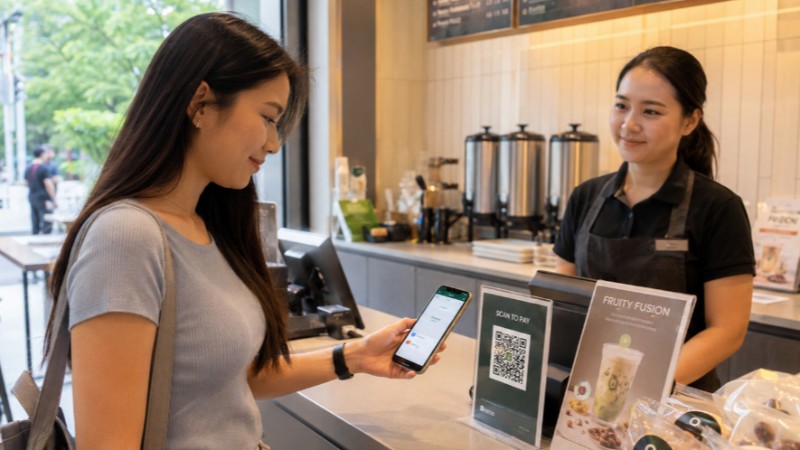
In-store payments are changing quickly. Customers no longer expect checkout to mean inserting a card, signing a receipt, or handing over cash. In many markets, they now tap a contactless card, hold a phone near a terminal, scan a QR code, or pay through a mobile wallet.
For businesses and merchants, this shift creates an important question: should you accept NFC payments, QR code payments, or both?
NFC and QR code payments are often grouped together as “contactless” or “digital” payment methods, but they work in very different ways. They require different hardware, create different checkout experiences, involve different security risks, and may carry different cost structures depending on the market and provider.
This guide explains the key differences between NFC payments and QR code payments, including speed, setup requirements, fees, security, POS integration, customer adoption, and business use cases.
What Are NFC Payments?
NFC stands for Near Field Communication. NFC payments allow a customer to pay by placing a contactless card, smartphone, smartwatch, or wearable device close to an NFC-enabled POS terminal.
Common examples include:
• Contactless debit and credit cards
• Apple Pay
• Google Pay
• Samsung Pay
• Wearable payment devices
• Tap to Pay or SoftPOS solutions
In a typical NFC payment, the customer taps their card or device near the terminal. The terminal communicates with the payment device over a very short distance. The transaction data is then sent through the merchant's payment processor, acquirer, card network, and issuing bank for authorization.
For the customer, the experience feels simple: tap and go.
For the merchant, NFC payments are usually part of a broader POS and card acceptance setup. They are common in supermarkets, convenience stores, quick-service restaurants, retail chains, transportation systems, and any checkout environment where speed matters.
What Are QR Code Payments?
QR code payments use a scannable code to start or complete a payment. Instead of tapping a card or phone on a terminal, the customer scans a QR code with a mobile wallet, banking app, or payment app.
There are two common types of QR code payment flows.
The first is merchant-presented QR. The merchant displays a QR code on a counter, printed sign, receipt, table card, POS screen, or payment terminal. The customer scans the code and confirms the payment in their app.
The second is consumer-presented QR. The customer opens a wallet or payment app and displays a QR code. The merchant scans that code with a POS device, scanner, or mobile app to complete the payment.
QR code payments are especially common in markets where mobile wallets or bank apps are widely used. They are also popular among small merchants because some QR setups require very little hardware. A static QR code can be printed and placed at the counter, while a dynamic QR code can be generated for each order with a specific amount and transaction reference.
QR code payments are often used in restaurants, cafés, food trucks, pop-up shops, service businesses, parking, delivery, self-ordering, and markets with strong mobile wallet adoption.
NFC Payments vs QR Code Payments: Quick Comparison
Factor | NFC Payments | QR Code Payments |
Customer action | Tap card, phone, or wearable | Scan a code or show a code |
Hardware | NFC-enabled POS terminal, SoftPOS device, or Tap to Pay setup | Static QR code, POS screen, payment app, scanner, or mobile device |
Checkout speed | Usually very fast | Depends on app, scanning, confirmation, and network speed |
Typical use case | High-speed in-store checkout | App-based payments, table payments, small merchants, wallet-led markets |
Customer requirement | Contactless card or mobile wallet | Smartphone and supported payment app |
Cost structure | Often card-network based | Depends on wallet, bank rail, provider, or local payment scheme |
Security model | EMV, encryption, tokenization, terminal certification | App authentication, QR validation, payment confirmation, fraud controls |
POS integration | Usually strong when connected to a modern POS | Strong with dynamic QR; weaker with manual or static QR |
Best fit | Retail, convenience stores, transit, fast checkout | Restaurants, micro merchants, service businesses, emerging wallet markets |
The most important difference is this: NFC payments are designed for fast terminal-based checkout, while QR code payments are designed for app-based or code-based payment flows.
Key Difference 1: Checkout Speed and Customer Experience
NFC payments are usually faster at a traditional checkout counter. In most card or wallet-based NFC transactions, customers do not need to scan a code, type an amount, or manually confirm merchant details. They simply tap a card, phone, or wearable near the terminal.
This makes NFC well suited for supermarkets, convenience stores, coffee shops, fast-food restaurants, transit systems, stadiums, and other high-volume checkout environments.
QR code payments usually involve more customer steps. A customer may need to open an app, scan the code, check the merchant name, confirm the amount, and authenticate the payment.
However, QR is not necessarily worse. It is simply better for different situations. In restaurants, for example, a QR code can be placed on the table or bill. Customers can scan, pay, add a tip, split the bill, or leave without waiting for staff to bring a payment terminal.
In short: NFC usually wins for speed at the counter. QR code payments often win for flexibility away from the counter.
Key Difference 2: Hardware and Setup Requirements
NFC payments usually require an NFC-enabled POS terminal or a certified mobile device that supports Tap to Pay or SoftPOS acceptance. For established retailers, this is often not a major issue because many modern POS terminals already support contactless payments.
QR code payments can have a lower setup barrier. A basic QR setup may only require a printed code linked to a payment account. This makes QR attractive for small merchants, food trucks, pop-up sellers, market vendors, and service providers.
However, merchants should understand the difference between static and dynamic QR codes.
A static QR code stays the same for every payment. It is easy to deploy, but customers may need to enter the payment amount manually. This can create risks such as incorrect amounts or fake payment confirmations.
A dynamic QR code is generated for a specific transaction. It can include the order amount, merchant account, table number, invoice reference, or transaction ID. Dynamic QR is usually better for formal retail and restaurant operations because it is easier to reconcile with the POS system.
In short: QR has a lower hardware barrier, but NFC often provides stronger checkout infrastructure.
Key Difference 3: Merchant Fees and Payment Costs
Many merchants ask: are QR code payments cheaper than NFC payments?
The answer is: sometimes, but not always.
NFC payments often run through card networks when customers tap a contactless debit card, credit card, or mobile wallet linked to a card. In those cases, merchants usually pay card-present processing fees, which may include interchange fees, assessment fees, and processor markup.
QR code payments can follow different payment rails. A QR payment may be connected to a mobile wallet balance, bank transfer, account-to-account payment system, local payment scheme, card-funded wallet, super app, or payment service provider.
Because of this, QR code payment fees vary widely by country, provider, and payment method. In some markets, QR may be cheaper because it reduces hardware costs or avoids traditional card-network fees. In other markets, a QR payment funded by a card or processed through a wallet provider may still carry merchant service fees.
Merchants should not assume that QR is automatically cheaper than NFC. The real question is not the technology alone, but the payment rail behind it.
In short: NFC may involve higher hardware or card-processing costs, while QR may reduce setup costs. But the final cost depends on the provider, scheme, and transaction flow.
Key Difference 4: Security and Fraud Risks
Both NFC and QR code payments can be secure when implemented properly. The difference is that they face different types of risk.
NFC payments usually rely on mature card-present security standards when processed through certified terminals and established payment networks. Contactless card and mobile wallet payments commonly use encryption, EMV technology, tokenization, and secure authentication.
QR code payments can also be secure, especially when they use trusted apps, wallet authentication, and dynamic transaction codes. But QR payments introduce operational risks that merchants should manage carefully.
Common QR-related risks include:
• Fake QR code stickers placed over real merchant codes
• Customers scanning the wrong code
• Phishing pages disguised as payment pages
• Fake payment confirmation screenshots
• Payments sent to the wrong account
• Staff failing to verify successful payment
• Static QR codes without transaction-level tracking
Merchants using QR payments should verify the merchant name, use dynamic QR codes where possible, check real-time payment notifications, and avoid relying only on customer screenshots.
In short: NFC is usually stronger for standardized terminal-based payments. QR can be secure, but merchants need stronger controls against code tampering and false payment confirmation.
Key Difference 5: POS Integration and Daily Operations
For merchants, accepting a payment is only one part of the job. The more important question is: can the payment be matched correctly with the order, receipt, customer, shift, refund, and settlement report?
NFC payments are commonly integrated into the POS terminal and payment processor. When a customer taps to pay, the transaction is usually tied directly to the sale. This makes it easier to manage receipts, refunds, taxes, tips, inventory, loyalty programs, staff reporting, settlement reports, and end-of-day reconciliation.
QR code payments can also be well integrated when they are dynamic and connected to the POS system. For example, a restaurant POS can generate a QR code for a specific table bill, allowing the customer to pay the correct amount and automatically close the order.
However, static QR codes can create operational gaps. If customers manually enter amounts, staff may need to check whether the payment was successful and whether the amount matches the order.
In short: NFC usually fits naturally into POS workflows. QR works best when it is dynamic and connected to the merchant's POS system.
Key Difference 6: Customer Adoption by Market
The best payment method often depends on where the merchant operates and what customers already use.
In card-first markets, NFC payments may feel natural. Customers are used to tapping debit cards, credit cards, phones, or watches. This is common in many parts of North America, Europe, Australia, and other markets with strong contactless card adoption.
In wallet-first or bank-app-first markets, QR code payments may be more familiar. Customers may already use mobile wallets or banking apps for everyday purchases. QR payments are common in parts of Asia, Latin America, and other markets where mobile-first payment systems grew quickly.
Customer behavior also depends on industry. A commuter buying coffee may prefer NFC because it is fast. A restaurant customer may prefer QR because they can pay at the table. A tourist may want to use an international card through NFC, while a local customer may prefer a domestic wallet through QR.
In short: payment acceptance should follow customer behavior. In card-heavy markets, NFC may be essential. In wallet-heavy markets, QR may be just as important.
Which Is Better for Different Business Types?
Different businesses have different checkout needs. NFC and QR code payments should be evaluated based on customer behavior, transaction speed, hardware cost, and operational workflow.
Retail Stores
For most retail stores, NFC payments are usually the stronger primary option. Retail checkout often depends on speed, reliability, receipts, refunds, and POS integration. Customers expect to tap a card or phone and leave quickly.
NFC is especially useful for:
• Grocery stores
• Convenience stores
• Apparel shops
• Pharmacies
• Electronics stores
• Quick-service retail
• High-volume checkout lanes
QR code payments can still be useful as an additional method. Retailers may use QR to accept local wallets, support promotions, enable loyalty campaigns, or serve customers who prefer app-based payments.
For retail, NFC is usually the default. QR is a valuable supplement when customer demand exists.
Restaurants and Cafés
For cafés and quick-service restaurants, NFC payments are usually better at the counter because customers can tap and leave quickly. This helps reduce queues during busy hours.
For full-service restaurants, QR code payments can be more useful. Customers can scan a code at the table, review the bill, add a tip, split the payment, and pay without waiting for staff to bring a terminal.
In many food-service environments, the strongest setup is not NFC or QR alone. NFC works well for counter checkout, while QR code payments work well for table service, self-ordering, digital menus, and pay-at-table experiences.
Small and Mobile Businesses
For small and mobile businesses, QR code payments can be easier to start with because they may require little or no dedicated hardware. A printed or digital QR code can help food trucks, market vendors, pop-up sellers, and independent service providers accept mobile payments with a lower setup barrier.
However, as transaction volume grows, NFC payments or Tap to Pay solutions can create a faster and more professional checkout experience. Small businesses that serve both card users and wallet users may benefit from offering both options.
For small merchants, QR may be the easiest starting point, while NFC can be a valuable upgrade for speed, trust, and POS integration.
Should Merchants Offer Both NFC and QR Code Payments?
In many cases, yes.
NFC and QR code payments are not always direct competitors. They solve different checkout problems.
NFC is best for fast, terminal-based, card-present transactions. QR is often better for flexible, app-based, low-hardware, or table-based payment flows. Merchants that serve different customer groups may benefit from accepting both.
Offering both can help merchants:
• Serve card users and wallet users
• Reduce checkout friction
• Support local payment preferences
• Improve table or self-service payments
• Add backup payment options
• Better serve tourists and younger mobile-first customers
However, more payment methods also mean more operational complexity. Merchants should make sure each payment method is properly integrated, secure, and easy to reconcile.
The goal is not to accept every payment method possible. The goal is to accept the methods that customers actually use and that the business can manage efficiently.
How to Choose Between NFC and QR Code Payments
Merchants can use the following checklist before deciding.
Ask these questions:
1. Do most customers use contactless cards, mobile wallets, or local payment apps?Is checkout speed critical to the business?
2. Does the business already use an NFC-enabled POS terminal?
3. Is the merchant trying to reduce hardware costs?
4. Are payments made at a counter, table, service location, or remotely?
5. Does the business need automatic order-payment reconciliation?
6. Are fraud, fake confirmations, or chargebacks a concern?
7. Does the merchant need tipping, refunds, receipts, loyalty, or inventory integration?
8. Are customers local, international, or mixed?
9. What are the true transaction fees and settlement timelines for each option?
If speed and POS integration are the top priorities, NFC is usually the better choice. If low-cost setup and app-based customer behavior are more important, QR code payments may be better. If the merchant serves a broad customer base, supporting both may be the strongest strategy.
Which Payment Method Should Your Business Choose?
NFC payments are usually the better choice for fast, terminal-based checkout, especially in retail stores, convenience stores, cafés, and transit environments.
QR code payments are often better for low-hardware, app-based, or table-service payments, especially for restaurants, small merchants, and mobile businesses.
For many businesses, the best option is to support both. NFC provides speed and POS integration, while QR code payments add flexibility for customers who prefer mobile wallets or app-based checkout.